

On January 31, 2026, Democrat Taylor Rehmet won the Runoff for Texas Senate District 9 with a margin of 57.21%–42.79% (that’s a 14+% victory margin) over Republican Leigh Wambsganss. For the voters in SD9, they gave Donald Trump a 17 point margin in November 2024, and gave former State Senator Kelly Hancock a 20 point margin in November 2022.
Some people will point to voter history and declare that a “huge number of Republicans crossed over” to vote for Rehmet. I don’t want to rely on someone else’s chart, so I pulled all of the voter history from Tarrant County and bounced the voter rolls off of it. You have to remember Texas doesn’t have “registration” for parties. The main way people talk about the partisan nature of things is how people vote. We don’t know WHO you vote for, but we do know WHICH elections you vote in. And in the party Primaries, you can only vote in one or the other. So we know who is voting in Republican Primaries, who is voting in Democratic Primaries, and who just voted in General elections. This is where it lands:
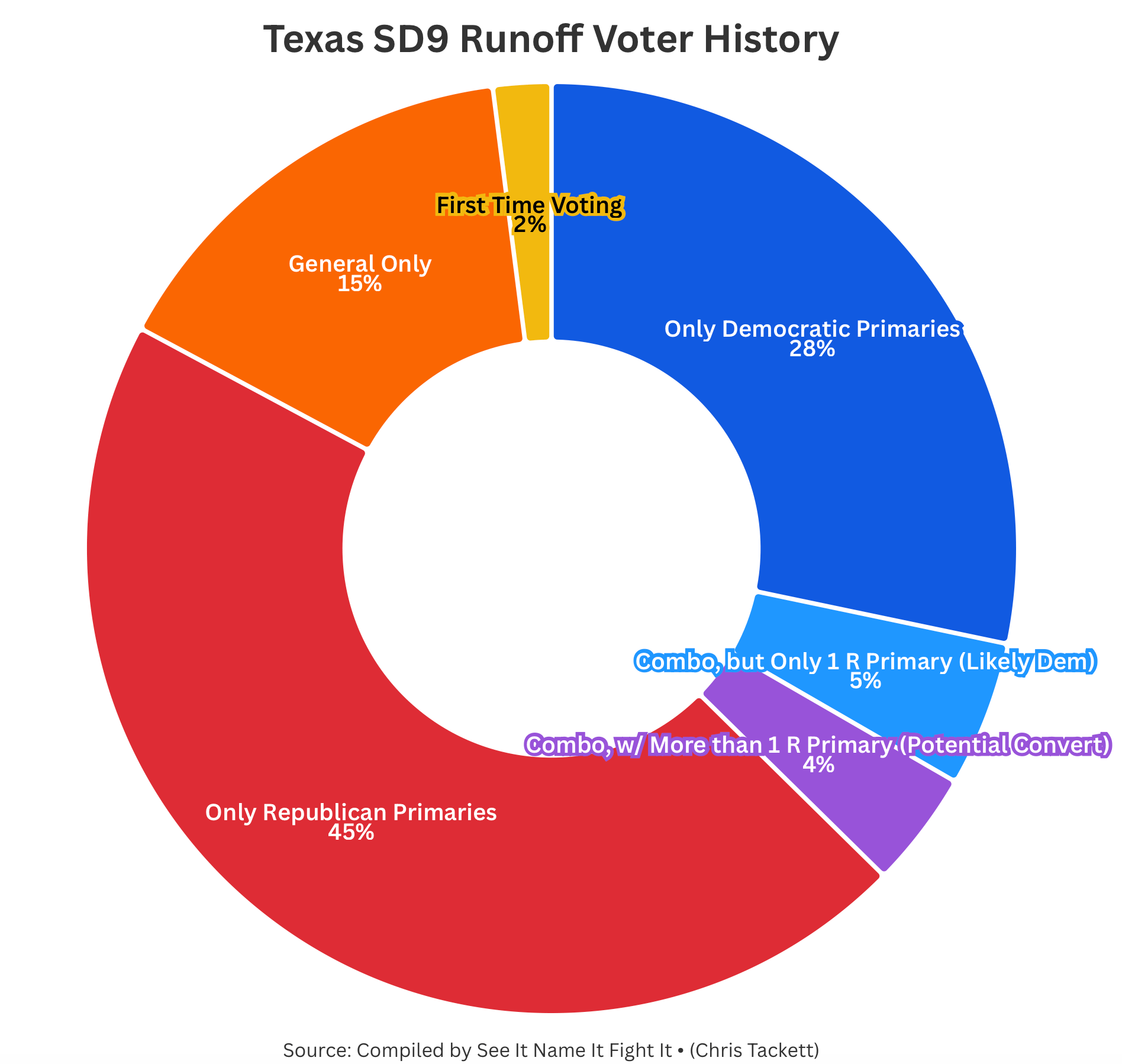
So let’s do a quick run through on the numbers
28% of those who voted have history ONLY voting in Democratic Primaries and Generals
5% voted in both Primaries, but only one Republican Primary (and Generals)
4% voted in both Primaries, with multiple of those being Republican
45% voted in ONLY Republican Primaries (and Generals)
15% have no Primary voting history at all, and ONLY vote in Generals
Some have pointed to voter-history and even in my chart 45% of runoff voters had participated only in Republican primaries and declared this proof that “huge numbers of Republicans crossed over” to vote for Rehmet. That take is misleading, and getting into the next layer of understanding, the partisan voter-score chart proves why.
In Texas, the voter score runs 0–100, where higher scores = stronger/more consistent Democrats and lower scores = stronger/more consistent Republicans. This is the single most reliable predictive metric we have because it combines primary history, general-election voting patterns, demographics, geography, turnout habits, and more. BUT EVEN WITH THAT, it isn’t perfect, especially where there isn’t much history, as those who block walk, call bank, or text can tell you.
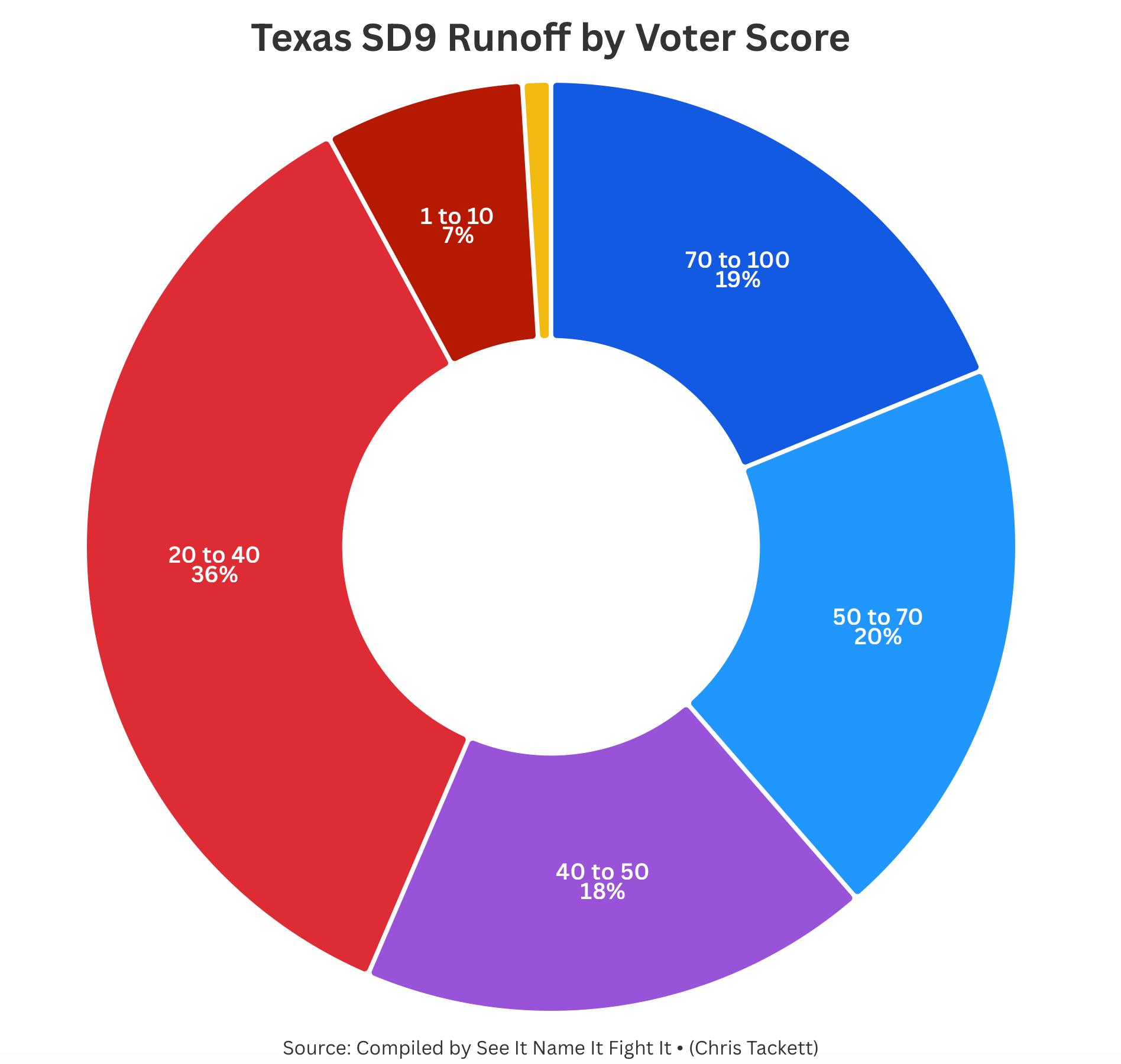
Here’s how the actual runoff electorate broke down by voter score:
- 70–100 (strong Democrat): 19%
- 50–70 (lean Democrat): 20%
- 40–50 (true moderates/crossover zone): 18%
- 20–40 (yep, they are Republican): 36%
- 1–10 (strong Republican): 7%
- No score (Usually newly registered): 1%
That means 39% of runoff voters were 50+ (leaning or strong Democrat), while another 18% sat in the 40–50 band, the exact zone where two very different groups land:
1. Strategic Democratic-leaning voters who regularly vote in Republican primaries because, in “deep-red” Texas, the GOP primary is the only election that matters in most cycles. These are people who want to block the craziest Republican and then turn out to vote for Democrats in November and in runoffs like this one.
2. True independents and general-election-only voters who live in mixed areas and get scored as moderates.
Add it up: 57% of the runoff electorate scored 40 or higher — i.e., moderate to strong Democratic-leaning who turned out in a low-turnout January special and gave Taylor Rehmet 57% of the vote. That’s right. The voters score aligned ON THE NOSE to the actual tally on the vote. What we saw wasn’t massive Republican crossover. It was Democrats (many of whom have been forced to play in GOP primaries for years) finally getting a meaningful choice and showing up. And yes, there were some Republicans who crossed over. But not the kind of numbers being thrown around.
The “45% only Republican primaries” number looks dramatic until you remember the Texas structural reality: for decades, Democratic-leaning voters in red districts have had no choice but to vote in the Republican primary if they wanted any say at all. That history artificially inflates the “Republican primary voter” share and makes the electorate appear far redder than it actually is. It influences voter scores and impacts how people see a place like Tarrant County.
The voter-score pie chart cuts through distortion and shows the truth: this was a moderate-to-Democratic-leaning electorate that turned out on a cold Saturday and delivered a Democrat a 14-point win in a Trump +17 district.
Taylor Rehmet didn’t win because masses of Republicans suddenly defected. He won because Democrats, moderates, and years-worth of frustrated strategic primary voters finally had a runoff worth voting in. And they showed up. And with a win and some momentum, they will keep showing up and drive real change in this county, this state, and this country. As goes Tarrant, goes Texas, goes the Country.
We are the frontline in the fight for our Democracy. We the people are showing up.
See It. Name It. Fight It.
Brilliant stuff. I didn’t buy the crossover theory either.
1. Every vote matters
2. I appreciate and admire your storytelling through analytics.
3. Did I mention every vote matters?