

49,556. It was our worst day of early voting so far, and it shows exactly where the rest of this race will be decided
I'll start with the hard part. Monday was the weakest day for Democrats since early voting began. Of Monday's in-person voters, 26.6% had last voted in a Democratic primary, the lowest share of any day so far. 29.2% had last voted in a Republican primary. That's a Republican edge of nearly 3 points, the second day Republicans have won and the widest Republican margin of any day.
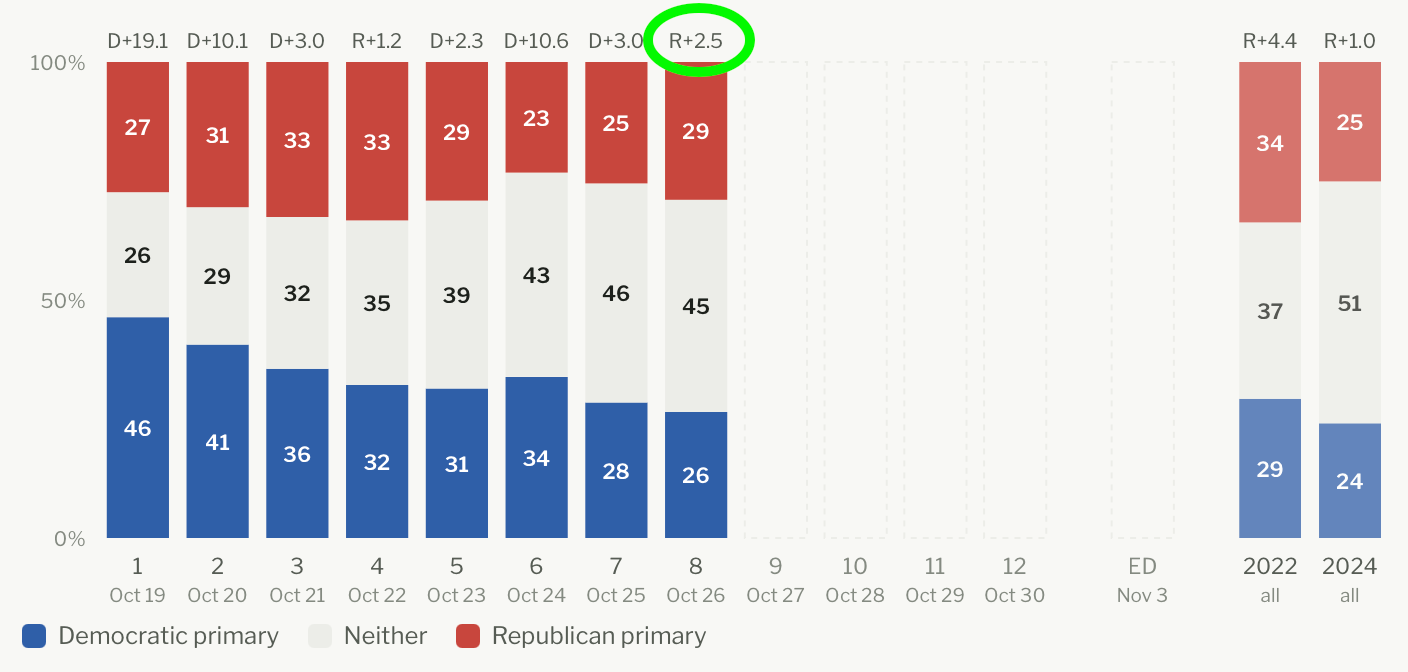
I'm not going to dress it up. It wasn't a good day.
The topline is still strong
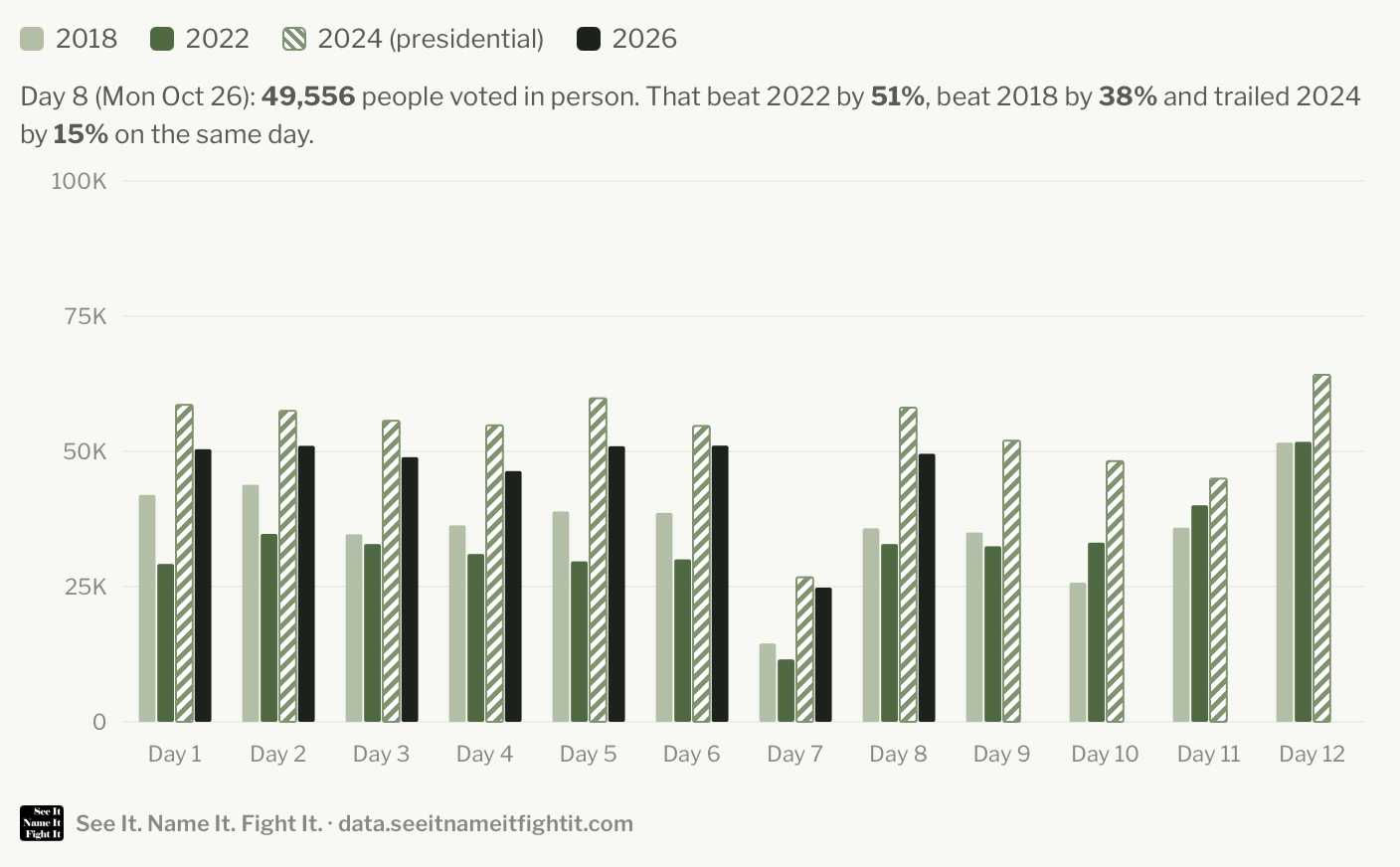
Turnout hasn't slowed. 391,302 Tarrant County voters have now cast a ballot: 373,100 in person and 18,202 by mail. That's 57% ahead of the same point in 2022, and we have already passed two-thirds of the entire 2022 midterm vote.
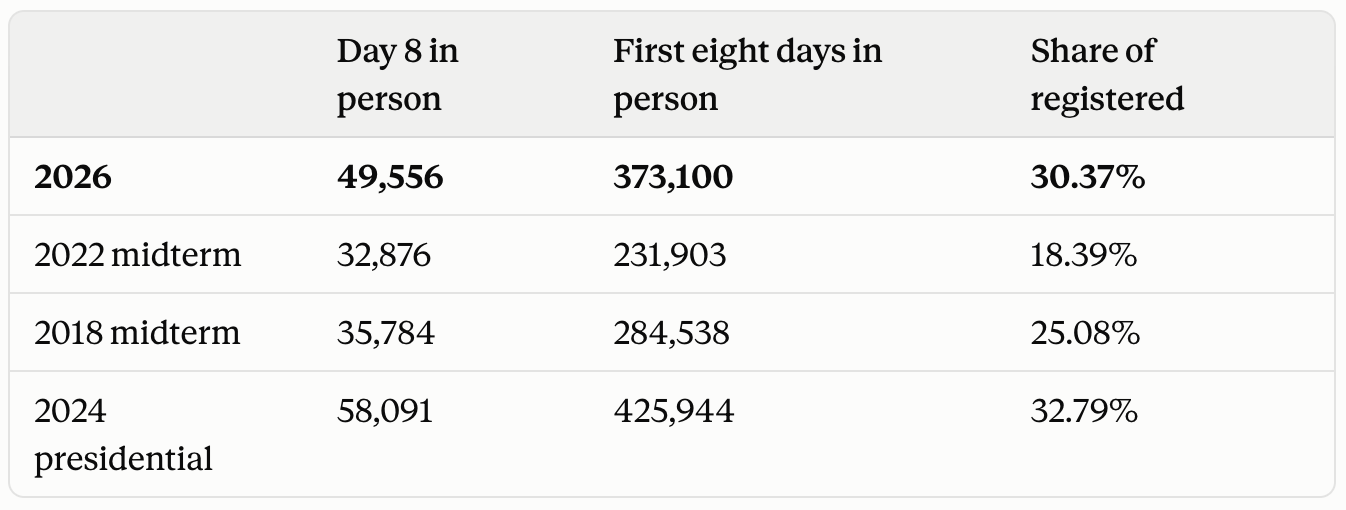
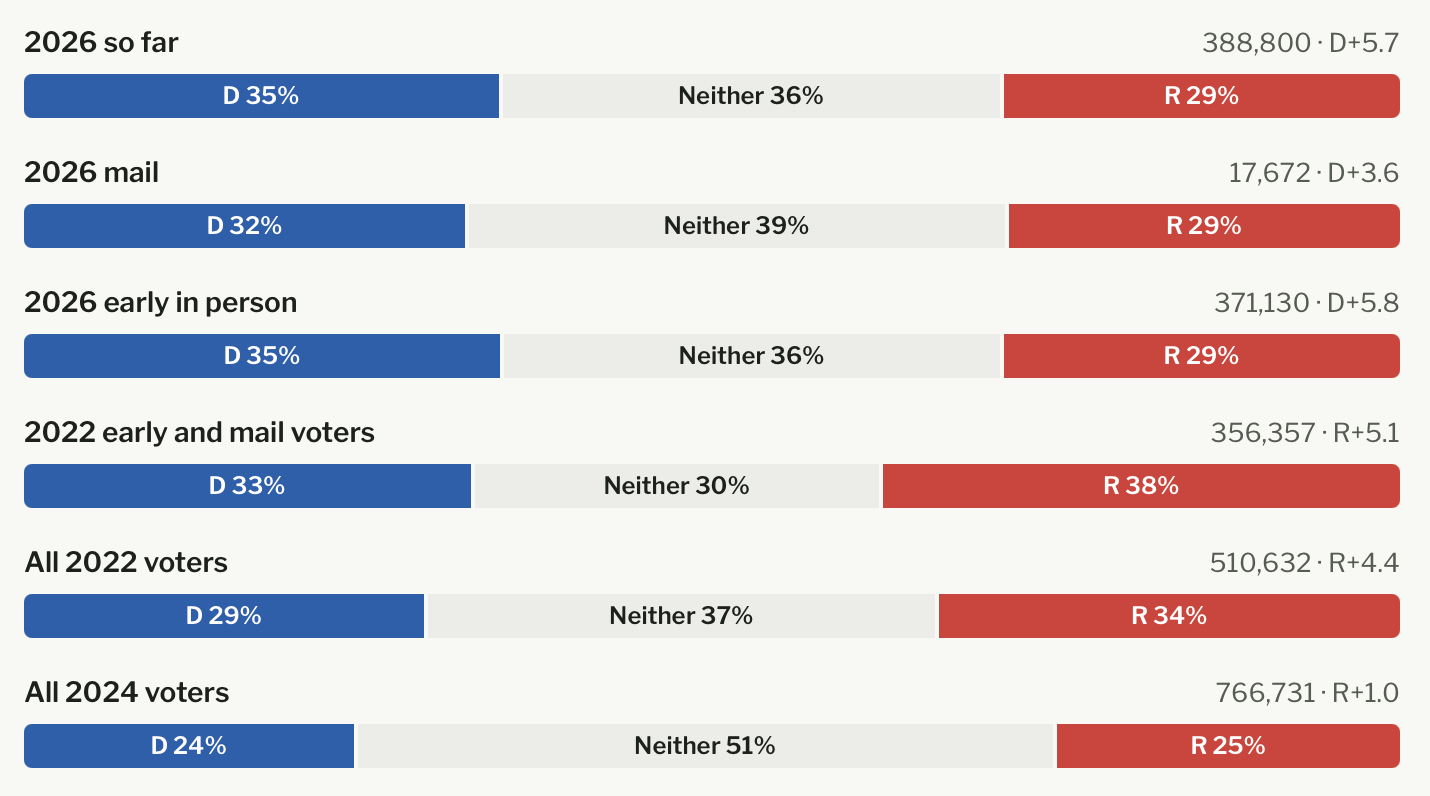
Three in ten registered voters in this county have already voted, with four days of early voting still to go. Across the whole early electorate, Democratic primary voters still lead Republican primary voters by about 6 points. In 2022, that same early electorate leaned Republican by 5.
Why Monday happened
Three things came together on Monday.
The Dem base is mostly done. 66% of active Democratic primary voters in Tarrant County have already voted. For Republican primary voters, it's 56%. Dems banked votes early, and that was the point. But it means each new day has fewer Democrats left to bring out.
The Republican base still has more to give. About 69,000 Democratic primary voters haven't voted yet. About 89,000 Republican primary voters haven't. That gap of roughly 20,000 voters will keep showing up in the daily numbers for the rest of the week.
The weekend voters went back to work. Saturday and Sunday brought out the youngest, most diverse electorate of early voting. On Monday, voters 65 and older went from 19% of Sunday's voters to 29%. The median voter went from 51 to 54. White voters went from 57% to 59%. Weekdays favor people with flexible schedules, and that's a more Republican group.
The two races that help decide the Commissioners Court
Two seats (along with the County Judge race) decide who controls the Tarrant County Commissioners Court: Precinct 2, where Jared Williams faces Tony Tinderholt, and Precinct 4, where Nydia Cárdenas faces Manny Ramirez. Both precincts were redrawn in 2025, and both voted Republican in 2024 on today's lines: Precinct 2 by about 7 points and Precinct 4 by about 16.
Here's where the early vote stands in each, by most recent primary:

Precinct 2 has moved 11 points toward Democrats. Its early electorate leaned Republican in 2022. This year it leans Democratic. Turnout is running above the county average, and two-thirds of the precinct's Democratic primary voters have already voted.
Precinct 4 has moved 13 points, and it's a dead heat. In a precinct drawn to elect a Republican, Democratic and Republican primary voters are tied in the early vote. That's the single biggest shift in either race. Precinct 4 also has the lowest turnout of any commissioner precinct, at 28%.
Monday showed the risk in both. Monday's voters leaned Republican in Precinct 2 by 2 points and in Precinct 4 by 7. And in both precincts there are more Republican base voters left than Democratic ones:

That's a Republican base advantage of about 6,600 voters in Precinct 2 and nearly 10,000 in Precinct 4. Neither camp's base will settle these races, though. Precinct 4 alone has 190,000 Neither voters who haven't voted yet, and 62% of them are under 45. Precinct 2 has 172,000, and 58% of them are under 45. These two races, and control of the court, will be decided by younger voters who have never picked a party primary.
Where the race across the county is now
Monday showed something that didn't change. 44% of Monday's voters have never voted in a Democratic or Republican primary. That's 21,560 people in a single day, more than either party's base.
About 700,000 active voters in that group haven't voted yet. Only 17% of them have. They aren't anyone's base, and they don't vote out of habit. They vote when someone gives them a reason. The Democratic base did its job in week one. The rest of this election belongs to the people who haven't decided to show up yet.
What we do now
The plan should be clear:
Reach the voters who don't vote in primaries. They're younger and more diverse, and they look like this county. They are the margin, nowhere more than in Precincts 2 and 4.
Use the early morning and evenings. Saturday showed what this electorate looks like when working people can vote. Make sure everyone knows what their nearest polling place is and that it opens at 7am and closes at 7pm through Friday.
Bring someone. Our remaining base voters are the hardest to reach. A ride, a call or a text from someone they know is what moves them.
Monday was a bad day. A bad day isn't a bad election.
Primary history isn't party registration, and it isn't a forecast. It tells us who has shown up, and who still could.
Keep going
Four days of early voting are left, through Friday, October 30. Vote, bring someone, and if you live in Precinct 2 or Precinct 4, bring two.
Follow every day of early voting at data.seeitnameitfightit.com/turnout.
See It. Name It. Fight It.
I'm phone banking starting this afternoon and for the rest of the week and into Election Day.
It’s a good sign to see non-primary voters turn out. With Trump’s approval in the low 30s—even worse among Independents—what’s driving people to show up isn’t “things are going great, let’s see more of this” but the opposite.